

Smoke Control Dampers
Controlling Smoke. Protecting Lives.
Silent Guardians:
The Critical Role of Smoke Dampers in Fire Safety
At Meritas, we believe the most effective safety systems are often the ones you never see. While fire dampers create a passive barrier against flames, smoke dampers actively protect your building’s air quality during an emergency.
More importantly, smoke travels faster than heat and remains the primary threat to life in a fire. Therefore, you cannot afford to overlook these critical devices. As a result, smoke dampers play an essential role in any modern fire strategy, actively containing danger and protecting occupants when it matters most.
What are Smoke Control Dampers?
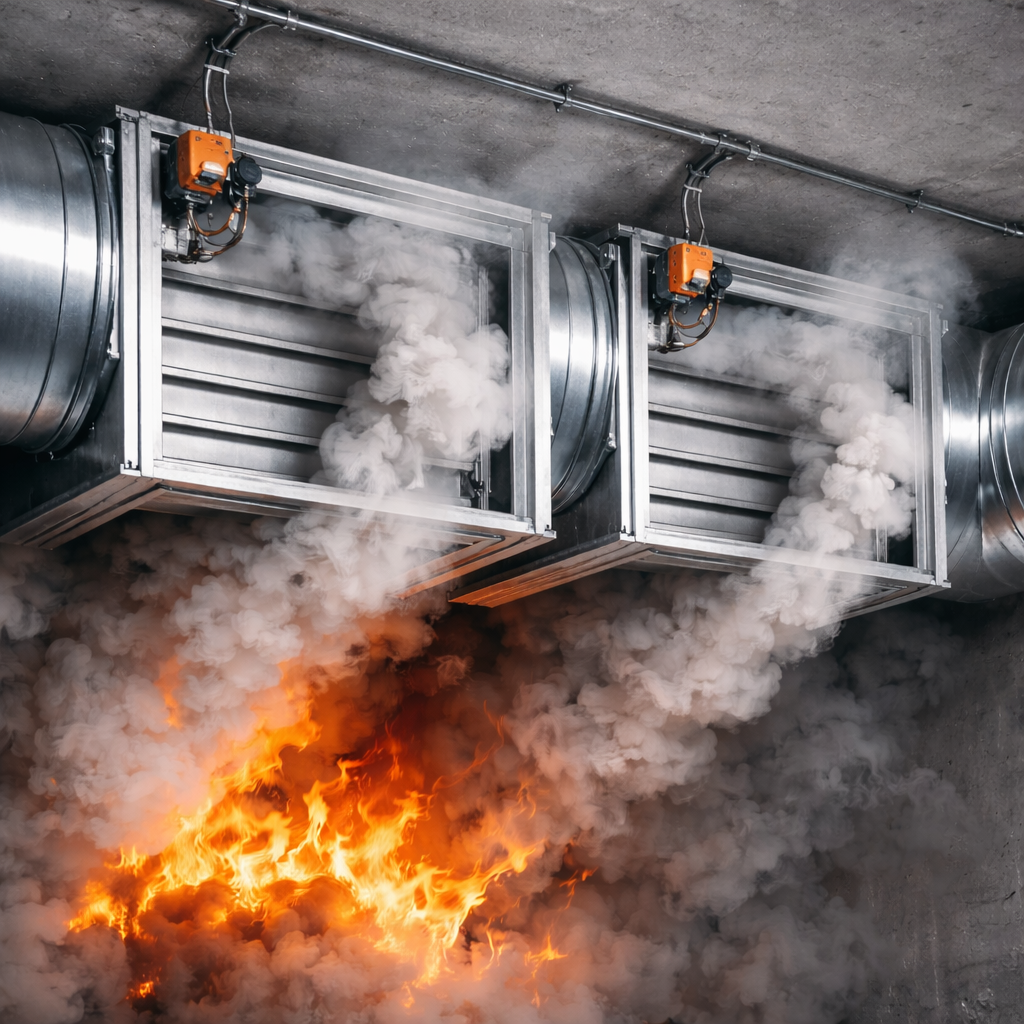
Unlike standard fire dampers, which rely on a melting fusible link, smoke control dampers operate as sophisticated, motorised components. In contrast, manufacturers equip them with electric actuators and integrate them directly into the building’s fire alarm system or, alternatively, a dedicated smoke control panel. As a result, these systems respond with precision and speed when every second counts.
Importantly, they do not wait for high temperatures to trigger a reaction. Instead, smoke detection systems activate them at the earliest signs of danger. Therefore, they respond during the most critical initial stages of a fire rather than after conditions have already deteriorated. By doing so, they help contain smoke movement before it spreads uncontrollably.
Ultimately, this proactive response plays a crucial role in maintaining “tenable conditions” within escape routes. In other words, smoke control dampers actively protect evacuation paths, thereby supporting safe egress and significantly enhancing the overall life safety strategy.
The Role of Smoke Control Dampers in Fire Strategy
The primary mission of these devices is to manage the movement of toxic gases.
Depending on your building’s specific design, smoke dampers perform two essential functions:
- Containment: They close automatically to prevent smoke from migrating through ductwork into protected areas like stairwells and lobbies.
- Extraction: Conversely, they can open to assist mechanical extract systems in pulling smoke out of the building.
Furthermore, in complex structures, these systems are highly coordinated.
For instance, while the fire-affected floor extracts smoke, dampers on other floors “lock out” in the closed position to ensure the smoke does not bypass fire-resistant barriers.
Compliance and British Standards
Because these are life-safety devices, strict regulations govern their performance. In particular, manufacturers and installers must ensure that smoke dampers meet the requirements of BS EN 1366-10.
By complying with this standard, they demonstrate that the dampers can operate reliably under the specific pressure differentials and temperature fluctuations that occur during a real fire incident. As a result, building owners gain confidence that the system will perform exactly as designed when it matters most.
Furthermore, the Building Safety Act 2022 has significantly strengthened the emphasis on “industry competence.” Consequently, organisations must appoint qualified professionals to install and maintain these systems.
In other words, you cannot treat smoke control as a routine mechanical task. Instead, you must rely on experts who understand the complex logic, sequencing, and integration involved in effective smoke control. Ultimately, this expert oversight ensures compliance, safeguards occupants, and reinforces the integrity of the entire fire safety strategy.
Essential Maintenance and Legal Duties
Even the most advanced smoke dampers are ineffective if they fail during a crisis. Under the Regulatory Reform (Fire Safety) Order 2005, the “Responsible Person” has a legal duty to ensure these systems are functional.
According to BS 9999, motorised dampers and Automatic Opening Vents (AOVs) require regular functional testing. We verify that:
- The actuators receive the required power.
- The signal response from the alarm is instantaneous.
- The system "failsafe" in the event of a total power loss.
Why Choose Meritas for Your Fire Strategy?
Ultimately, managing smoke requires precision, expertise, and a clear understanding of fire dynamics. In essence, it is a science, not a simple box-ticking exercise. Whether you are navigating the detailed requirements of Approved Document B or implementing a complex pressurisation system, you must apply informed judgement at every stage.
That is why our team takes a proactive, hands-on approach. From initial design through to final verification, we provide the technical oversight required to ensure every element performs as intended. Moreover, we coordinate closely with contractors and stakeholders to eliminate uncertainty and reduce risk. As a result, we help you maintain compliance, strengthen system performance, and, above all, protect the people who rely on your building every day.